Artificial intelligence
Restaurant AI Assistant for Sales, Stock and Cost Analysis
How a restaurant AI assistant works on your own data: example questions, how to check answers in reports, permissions, privacy and how to prepare your data.
UniPOS10 min read
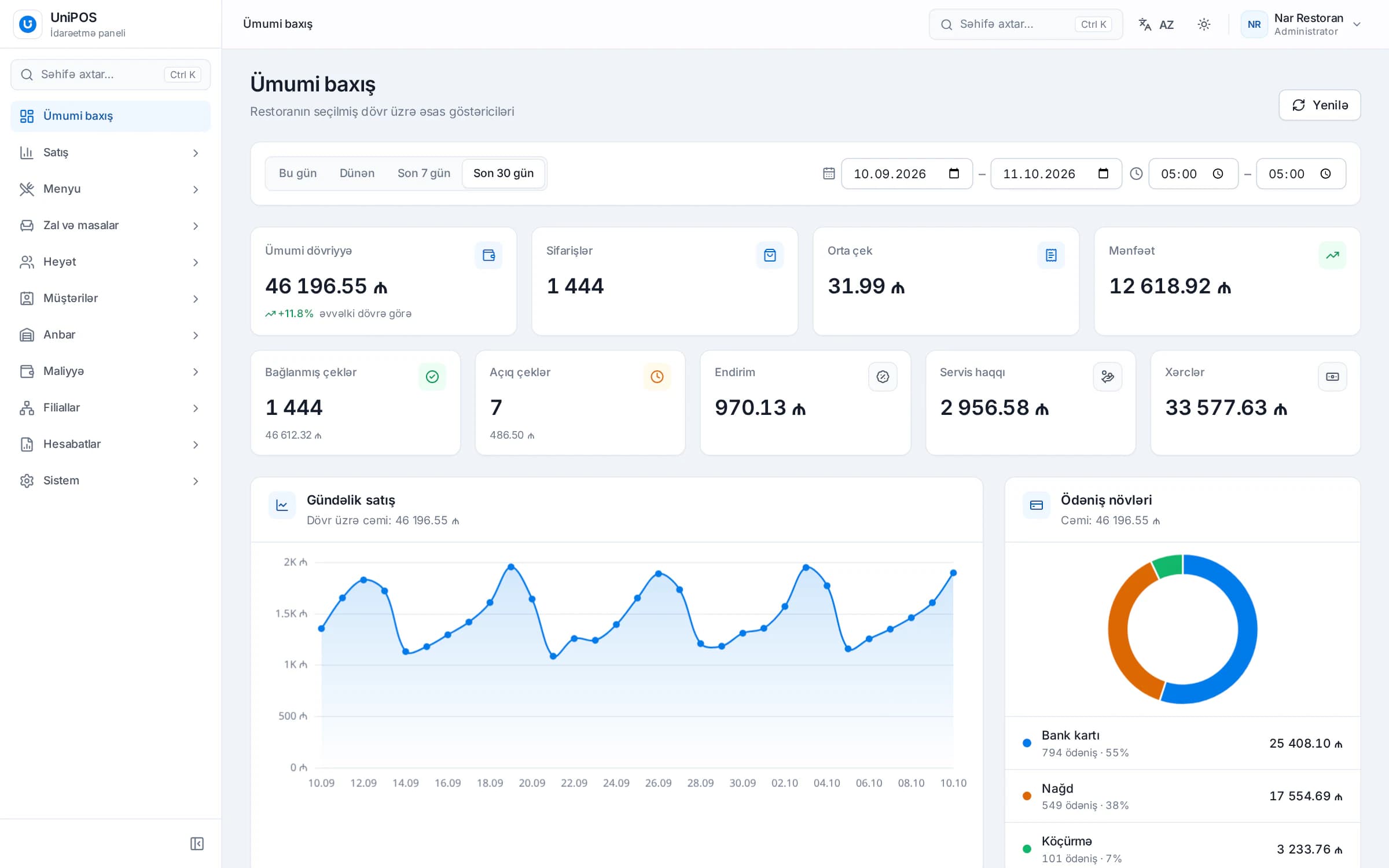
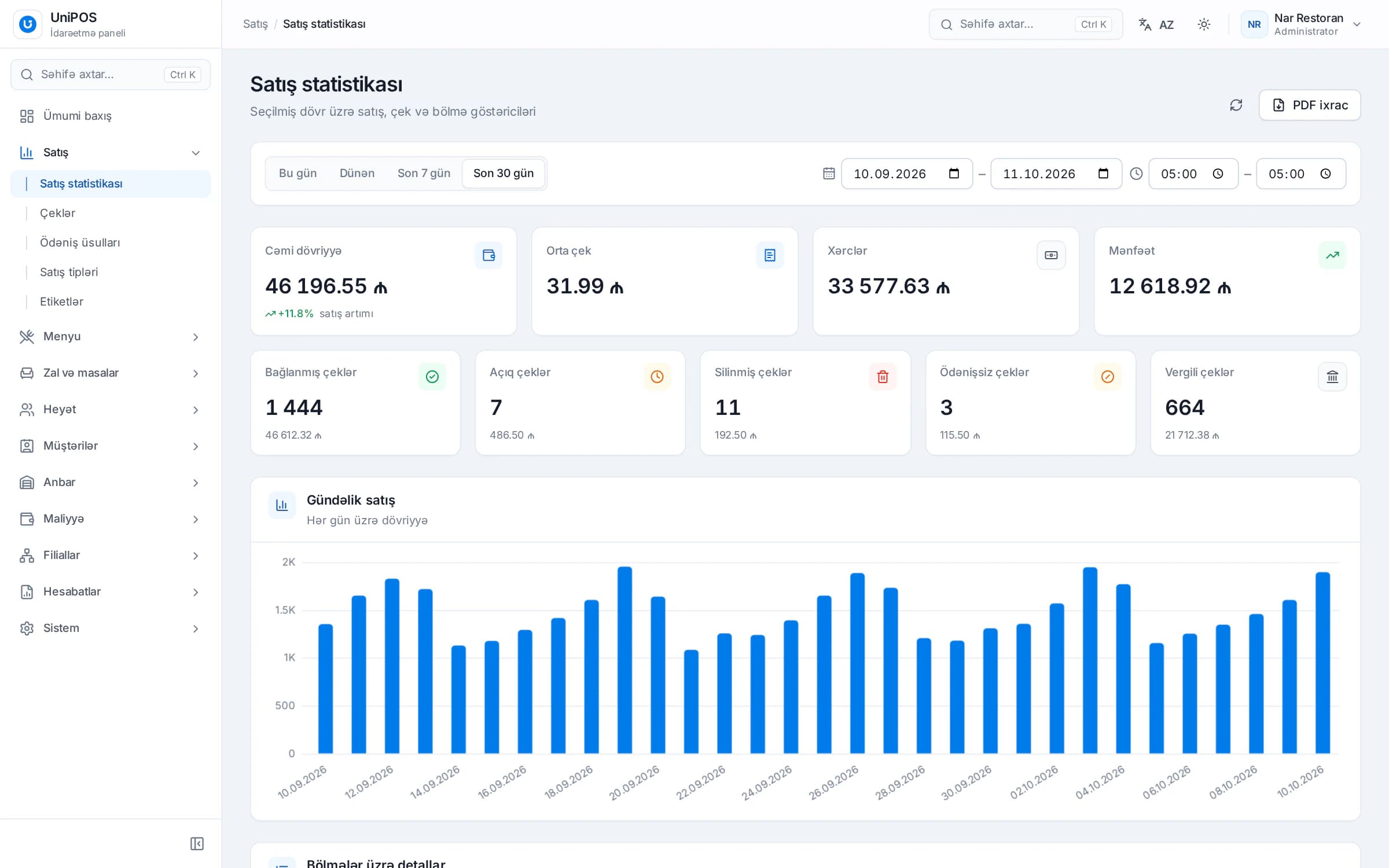
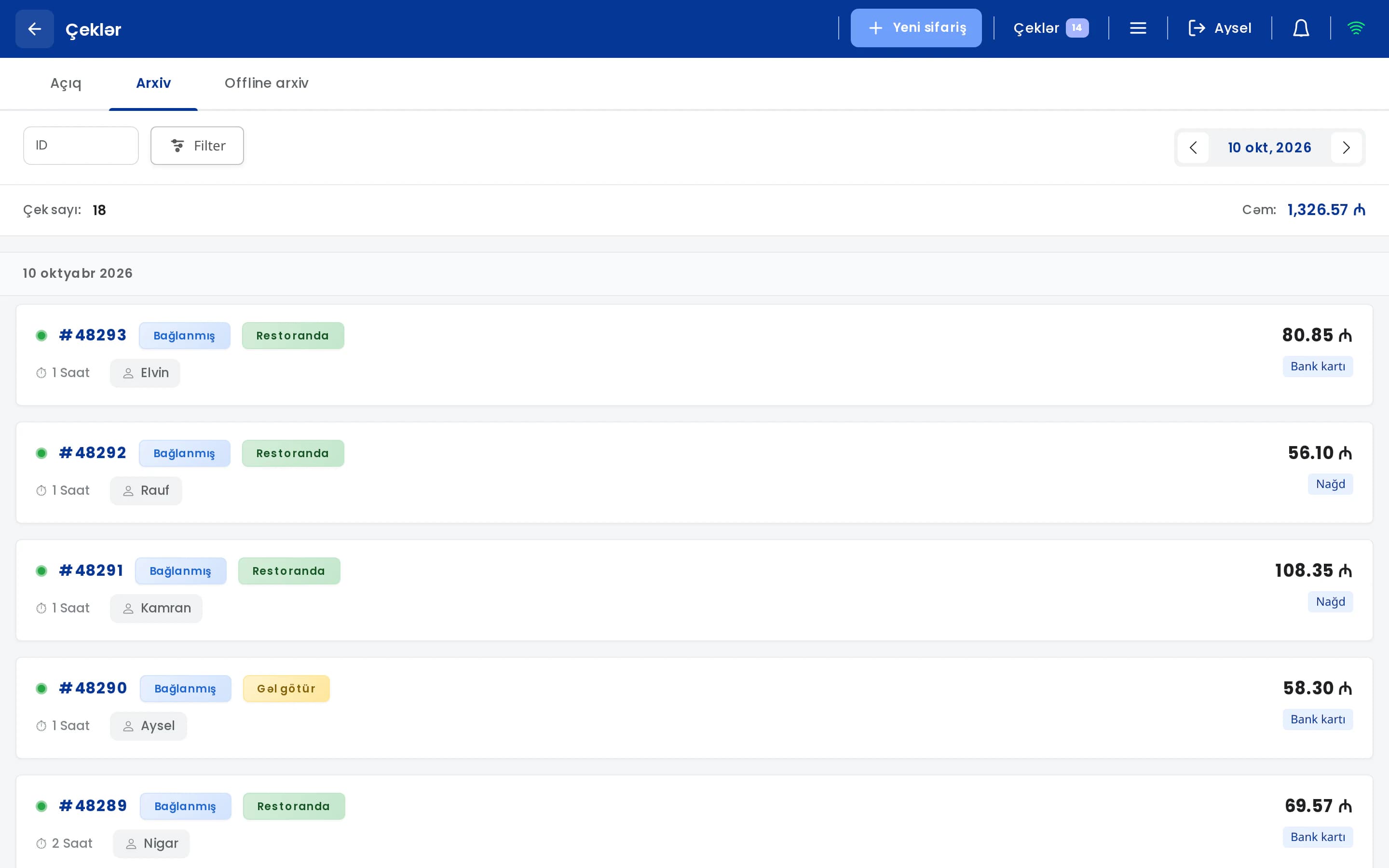
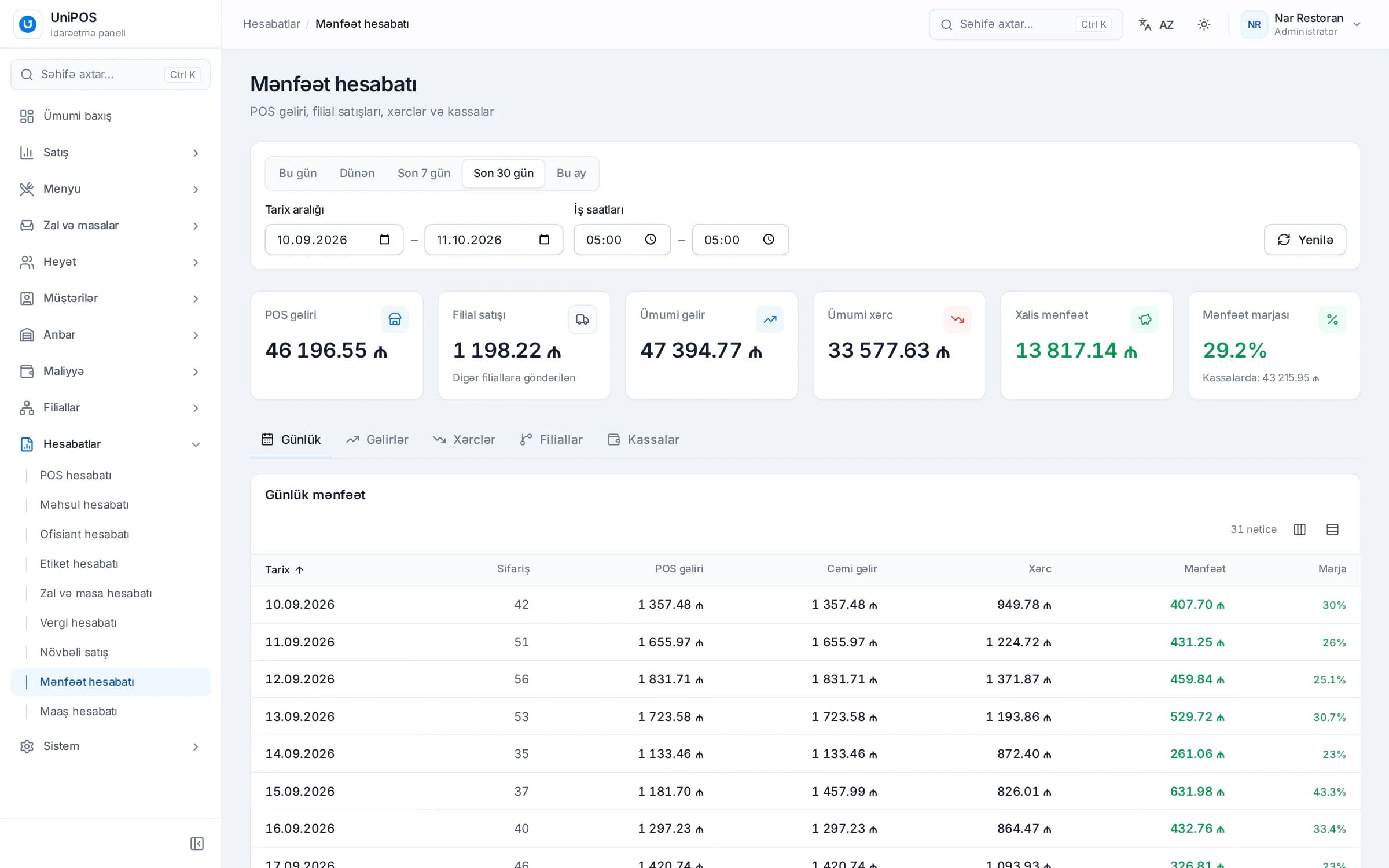
When people talk about artificial intelligence in restaurants, they often picture robot waiters or software that writes the menu on its own. In day-to-day management, the useful version is far more modest: an assistant that answers questions from your own data. The owner asks “How many checks do we have today?” or “Which items are running low?” and receives the answer as a table, without opening several reports.
This article explains what an AI assistant working on your sales data can and cannot do, which questions to ask, how to verify the answers and where to start. All figures in the examples are illustrative and given in AZN.
Contents
- What AI actually does in restaurant management
- What a restaurant AI assistant can and cannot do
- Example questions for an AI assistant
- A weekly sales analysis with AI
- Checking AI answers against your reports
- Permissions and data privacy
- Morning and evening briefing in Telegram
- Preparing your data before using AI
- The AI assistant in UniPOS Manager
What AI actually does in restaurant management
The form of AI that is genuinely useful in restaurant management today is the language model. It understands a question typed or spoken in everyday language, retrieves the relevant data and presents the answer in plain words. In practice, it's another way of working with your reports. The data stays the same; only the way you reach it changes.
Two approaches should be kept apart:
- General-purpose chatbots. They help you draft menu descriptions, job ads or a letter to a supplier. They don't know your sales, stock or expenses, though. To ask about numbers, you have to upload an Excel export, and that file may carry customer data to an outside service.
- An assistant that works on your own data. It uses the data from your POS and back office. Its answers are built from real checks, stock levels and expenses. Nothing needs to be uploaded, and the figures come from the same source as your reports.
This article is about the second approach. The benefit is easy to see. An owner opens reports on the phone several times a day, changes the date and branch to find a figure and moves between sections. Getting the same result with one question saves time, especially when the owner is away from the venue.
An AI assistant does not create new data. It finds, summarizes and explains what is already in the system. A complimentary item that was never recorded at the POS, or a supplier invoice that was never entered, won't appear in the answer either.
What a restaurant AI assistant can and cannot do
Setting the right expectations from the start prevents disappointment later. The table below shows the scope and the limits of an AI assistant working on sales data.
| Can do | Cannot do |
|---|---|
| Show today's, this week's and this month's sales, check count and average check | Change menu prices or set prices automatically |
| Compare periods, for example today with yesterday | Send an order to a supplier or create a purchase document |
| Rank best-selling items, categories and waiters | Delete a check, apply a discount or record a complimentary item |
| Show stock levels and roughly when an item will run out | Know what isn't in the system: weather, competitor prices, unrecorded transactions |
| Show recipe cost, margin and loss-making items based on recipe cards | Know for certain why sales dropped |
| Summarize expenses, cash balances and supplier debts | Guarantee that it never makes a mistake |
| Show suspicious actions and the activity log | Access sections the user has no permission for |
Some of the limits in the right-hand column come from the nature of the technology. The model sees numbers, but it doesn't always see causes. If sales dropped on Tuesday, the reason might be rain, a road closure or an event nearby. The assistant can only suggest possibilities; the manager makes the call.
The other limits are deliberate. An assistant that cannot change data cannot break anything, even if it misreads a question. Prices, orders and deletions are still handled at the POS or in the back office by staff with the right permissions.
Example questions for an AI assistant
Below are typical questions an owner or manager asks during the day, with illustrative answers. The last column shows where the figure can be checked.
| Question | Illustrative answer | Where to check |
|---|---|---|
| “How many checks do we have today?” | 142 checks closed today, 9 still open. Sales 3,280 AZN, average check 23.10 AZN. | Dashboard, check list |
| “Best-selling items this week” | Chicken kebab 214 portions, lentil soup 186, tea set 172, qutab 158, dushbara 131. | Product report |
| “Which items are running low?” | Butter: 2.1 kg left, enough for about 2 days at the current rate. Tomatoes: 4 kg, about 1 day. | Stock levels |
| “Compare with yesterday” | Sales today 3,280 AZN, yesterday 3,610 AZN. That's 330 AZN, or 9.1%, lower. Checks: 142 versus 151. | Sales statistics for both dates |
| “Waiter sales” | Elvin 1,120 AZN (38 checks), Narmin 980 AZN (35 checks), Rashad 760 AZN (31 checks). | Waiter report |
| “This month's expenses” | 18,450 AZN month to date: payroll 9,800, rent 4,500, utilities 1,650, other 2,500. | Expenses, profit report |
| “Which items are we selling at a loss?” | Salmon steak: recipe cost 17.80 AZN, menu price 17.00 AZN. The last purchase invoice shows a higher price for salmon. | The item's recipe card, recipe cost report |
How to phrase a question
The quality of the answer also depends on the question. A few simple rules make the results noticeably more precise:
- State the period. Instead of “How are sales?”, ask “Sales from Monday to today”. When no period is given, the model chooses one, and it may not be the one you meant.
- Name the branch. If you run several locations, include the branch name or say that you want a total for all branches.
- One topic per question. Ask three separate questions instead of “sales, expenses and stock”. Each answer is more precise and easier to check.
- Refine the answer. After the first answer, you can write “Break this down by category” or “Compare with last week”. That's faster than changing report filters one by one.
Asking by voice
Typing isn't always practical. A manager may be receiving a delivery in the storeroom, talking to the chef or greeting guests. In those moments, asking by voice is more convenient. You speak in everyday language, for example: “Compare today's sales with yesterday, by category.” The answer still arrives as text and a table, so you can read and copy it later. When you ask by voice, state the period and the branch just as clearly.
A weekly sales analysis with AI
The value of an assistant shows most clearly in a sequence of questions. In the example below, a manager reviews last week on Monday morning. The figures are illustrative.
First question: “Compare last week's sales with the week before, day by day.”
| Day | Week before (AZN) | Last week (AZN) | Difference (AZN) |
|---|---|---|---|
| Monday | 2,950 | 3,020 | +70 |
| Tuesday | 3,100 | 3,080 | −20 |
| Wednesday | 3,240 | 2,610 | −630 |
| Thursday | 3,300 | 3,350 | +50 |
| Friday | 4,600 | 4,720 | +120 |
| Saturday | 5,200 | 5,310 | +110 |
| Sunday | 4,450 | 4,390 | −60 |
| Total | 26,840 | 26,480 | −360 |
The weekly gap is only 360 AZN. The table shows, however, that almost the entire drop happened on one day, Wednesday. Looking only at the weekly total, you could easily miss it.
Second question: “Which categories fell on Wednesday?” Illustrative answer: hot dishes down 410 AZN, drinks down 150 AZN, desserts down 70 AZN. Checks fell from 118 to 97, while the average check stayed roughly the same (27.46 versus 26.91 AZN).
That tells you something important: fewer guests came in, but those who did spent about as much as before. The problem is likely footfall, not pricing or service.
Third question: “Were there any deleted checks or suspicious actions on Wednesday?” Illustrative answer: 2 checks were deleted, both with a reason given, 46 AZN in total. No suspicious actions were recorded.
This is where the assistant's work ends. The numbers show that the loss lies in guest count, not at the register. The manager finds the cause: road works on the street had blocked the entrance that day. That information isn't in the system, so the assistant couldn't have known it. You could reach the same conclusion through reports; it would simply take several reports opened one after another.
Checking AI answers against your reports
Responsible AI tools usually display a warning that AI can make mistakes and that key figures should be checked in reports. UniPOS Manager shows this warning as well. It isn't a formality. A language model can misread a question, pick the wrong period or summarize figures incorrectly. Treat an AI answer as a starting point for a decision, not as the final number.
Apply these rules:
- Open the report before any decision involving money. Payroll, supplier payments, price changes or a serious conversation with an employee should rest on the report, not on a chat answer.
- Check the period. Which dates does the answer cover? Is “this month” from the 1st to today, or the last 30 days?
- Check the branch. With several locations, confirm whether the answer covers all branches or just one.
- Run parallel checks in the first weeks. For the first two weeks, compare 2-3 answers a day with the reports. When something doesn't match, the cause is usually a vague question or incomplete data in the system.
- Treat forecasts as estimates. “Butter will last 2 days” is based on recent usage. A holiday, a banquet or a menu change can shift that estimate.
The rule: an AI assistant is for finding an answer quickly. Decisions about money, staff and suppliers are made on the figures in your reports.
Permissions and data privacy
Sales, expense and payroll data are confidential business information. Decide in advance who gets access to the AI assistant and how much they can see. With an assistant that works on sales data, pay attention to the following:
- Read-only access. The assistant reads and explains data. It doesn't delete checks, change prices, place orders or create stock documents. However a question is phrased, nothing in the system changes.
- Permissions apply. Answers only cover the sections the user is allowed to view. If a stock keeper has no access to finance, the assistant won't show them profit or payroll figures.
- A separate AI permission. Employees need the AI permission before they can use the assistant. You decide who receives it.
- Customer contact details are hidden. Answers about customers don't include phone numbers or other contact details.
- Branches. Answers cover the branches the user can see. A manager who only has access to one branch won't see figures from the others.
Follow the same principle with general-purpose chatbots. Before uploading a customer list or a payroll sheet to an outside service, find out how that service stores data. Where possible, remove personal data from the file first.
Morning and evening briefing in Telegram
Not every manager has time to ask questions during the day. For some, a ready-made report works better: key figures arrive on the phone before work starts and again when the day ends. UniPOS Manager sends this report to Telegram. It contains the key figures, the points that need attention and an AI recommendation.
Separate reports are prepared for the manager, the stock keeper and the accountant, because each role watches different numbers. The table shows the general idea; the recommendations are illustrative:
| Role | Figures they usually watch | Illustrative AI recommendation |
|---|---|---|
| Manager | Sales, check count, average check, open checks, deletions | “Yesterday's check count was below the weekly average. 2 of the 3 deleted checks belong to the same shift and are worth reviewing.” |
| Stock keeper | Low-stock items, negative balances, stock movements | “Butter and tomatoes may run out in 1-2 days. Consider adding them to the next purchase.” |
| Accountant | Expenses, cash balances, supplier debts | “Utility expenses month to date are higher than in the same period last month. Review this category.” |
You choose when the report is sent and which branches it covers. For example, the morning report can go out an hour before opening and the evening report after closing time. Treat the recommendation like any other AI answer: it points your attention to the right place, and you make the decision.
Preparing your data before using AI
An AI assistant can't be more accurate than the data in your system. If the same dish is entered under three different names, the best-seller list will be wrong. Without recipe cards, the assistant can't answer questions about cost and margin. Before enabling the module, it's worth completing these steps:
- Clean up the menu. Merge duplicate items, archive the ones you no longer sell and assign categories correctly. Keep item names short and clear so you can refer to them by name in a question.
- Create a recipe card for every dish. Each card needs the gross weight, the trim loss and the unit of measure. Our article on inventory and food cost covers this in detail.
- Record purchases with invoices. Cost is based on purchase prices. When invoices aren't entered, cost is calculated at old prices and a loss-making item may go unnoticed.
- Record write-offs and complimentary items. A write-off without a reason, or a free item not recorded at the POS, distorts stock levels. The list of items running low then becomes unreliable too.
- Enter expenses by category. “This month's expenses” can only be answered correctly when all expenses are in the system.
- Give every waiter a personal PIN. If several people share one code, sales by waiter lose their meaning.
- Count stock regularly. After a stock count, balances match reality and run-out estimates become more accurate.
- Write a daily question list. Turn the 5-7 figures you check every day into questions. Since the assistant has a daily request limit, a fixed list helps you use it well.
These steps pay off even if you never use AI. A clean menu, recipe cards and regular stock counts make your ordinary reports more accurate as well. We explain how the POS and reporting fit together in our restaurant POS system guide.
The AI assistant in UniPOS Manager
In UniPOS, the AI assistant runs in the UniPOS Manager app for owners and managers (Android). A round button in the bottom-right corner of every screen opens it. Its answers use the same data as the POS and the back office.
The AI assistant is a module enabled separately for each restaurant and works with a daily request limit. We explain the terms during the demo. Without the module, all the figures are still available in the app's 17 reports and widgets. You can see the stock features on the inventory page.
See the AI assistant on real examples
In the demo we'll ask the assistant in UniPOS Manager about sales, stock and expenses and compare its answers with the reports together with you.
Request a demo